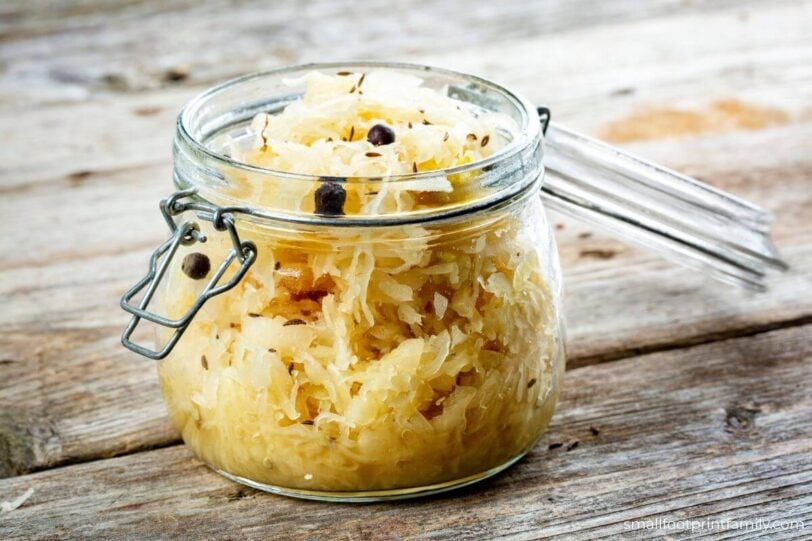

Making your own sauerkraut is a terrific way to preserve an abundant harvest of cabbage, and it’s a remarkably simple process that requires just two basic ingredients—shredded cabbage and salt.
Benefits of Fermented Foods
Lacto-fermentation was one of the only ways of safely preserving foods before refrigeration. All traditional or ancestral diets have always included raw, lacto-fermented foods with each meal: yogurt, kefir, chutney, miso, sauerkraut, kombucha, kimchi, etc. These living foods are packed with healthy, probiotic bacteria 1 that greatly enhance digestion, improve the nutrient and enzyme content of your food, and restore the healthy flora in your gut.
Unfortunately, the Standard American Diet is almost completely lacking in fermented, probiotic-rich foods, while being heavy in processed, nutritionally bankrupt foods that do not support a healthy gut microbiome. Add a little American stress to the mix, and we have a nationwide epidemic of Crohn’s disease, IBS, SIBO, reflux, candida, and colitis to show for it.
Food sensitivities and allergies due to leaky gut and “allergic colitis” are a growing problem for many people these days—especially kids—and these sensitivities contribute greatly to autism, asthma, arthritis, fibromyalgia, chronic fatigue, and other autoimmune disorders. And while conventional medicine has virtually nothing to offer to these conditions, there are nutritional solutions for many people.
Part of healing leaky gut, food sensitivities, and other digestive disorders for many of us—thereby ensuring a healthy immune system—involves eating fermented, cultured foods with every meal. Fortunately, these are very easy to make at home.
Other Fermented Foods You’ll Love:
How to Make Homemade Sauerkraut
If you’ve only eaten store-bought, canned sauerkraut, you owe it to yourself to try the homemade variety. Fresh, raw sauerkraut has a crunchier texture, a delightfully tangy flavor, and much greater potential for interesting recipes. It also costs very little to make.
Sauerkraut made with just cabbage and salt is basic and perennially delicious. But because fermentation is more art than science, feel free to get creative and add things like radish, onion, ginger, green apples, chili peppers, dill or fennel to your batch. Or try caraway seeds, cumin seeds, allspice berries, or juniper berries for different winter flavors!
Here is our basic family recipe for how to make sauerkraut:
Simple Homemade Sauerkraut
Equipment
- Food processor optional
Ingredients
- 1 packet vegetable starter culture, (optional)
- 2-3 medium heads cabbage, Napa, red or other cabbage (or mix and match them)
- 6-8 medium carrots, (optional)
- 2 Tbsp. sea salt, Do NOT use table salt
- 1 knob fresh ginger, about 3-inches (optional, to taste)
- 4 cloves garlic, (optional)
- 2 tsp. caraway seeds, allspice berries, or juniper berries (optional)

Instructions
- Thoroughly clean and scald the containers and utensils you will be using. Never use metal containers or utensils. Metal and fermentation don’t mix!
- Wash, drain and then cut your cabbages into halves or quarters. Grate, shred or chop cabbage by hand or with a food processor. Pieces should be about the size of a quarter, or smaller.2-3 medium heads cabbage
- Grate carrots. Peel and grate and ginger. Mince garlic, if using.6-8 medium carrots, 1 knob fresh ginger, 4 cloves garlic
- With wooden spoon or very clean hands, mix the shredded cabbage, carrots, garlic and ginger with the sea salt, and toss and mix thoroughly until salt dissolves.2 Tbsp. sea salt
- When juice starts to form on the cabbage from tossing, mix in the caraway seeds (if desired) and starter culture (if using).2 tsp. caraway seeds, 1 packet vegetable starter culture
- Pack the cabbage and other veggies firmly and evenly into clean quart-size Mason jars or a large fermenting crock until liquid comes out of the cabbage freely. Leave 2 inches of room at the top of the jars or 4-5 inches of room at the top of a crock.
- Make sure juice covers the cabbage completely! (This does not always happen unless the cabbage is fresh from the garden)
- If needed, make additional brine by putting 1 1/2 Tbsp. of sea salt into 1 quart of boiling, purified water. Dissolve salt and cool brine to room temperature before adding to the cabbage.
- Once cabbage is immersed in brine water, use a glass fermentation weight to keep the cabbage down under the brine. If you do not have a fermenting weight, put a freezer bag filled with water or even stones on top of the cabbage. (I use 2 large bags, one inside the other so that if the bag breaks, it will not water down the cabbage into a tasteless mess.) The cabbage must be completely submerged.
- Close the jars with airlock lids, or very loosely applied canning lids. This will keep air out of your kraut and keep the jar from building up too much pressure.
- Cover the jars with a clean towel and them in a cool (but not cold) area where the temperature will be between 65–75 degrees F. Fermentation will begin within a day, depending upon the room temperature.
- Check jars after 2 days. Scoop any scum off the top (it is harmless), and repack. Check every 3 days and repeat as necessary.
- After 2 weeks, sample the kraut to see if it tastes ready to eat. The flavor will continue to mature for the next several weeks.
- Refrigerate the sauerkraut to extend its shelf life.
Nutrition
Recommended for This Recipe


Resources
- ?anlier N, Gökcen BB, Sezgin AC. Health benefits of fermented foods. Crit Rev Food Sci Nutr. 2019;59(3):506-527. doi: 10.1080/10408398.2017.1383355. Epub 2017 Oct 20. PMID: 28945458.